


Про курс
This is a comprehensive program designed specifically for marine engineers who already work with scrubbers or are preparing to operate vessels equipped with Exhaust Gas Cleaning Systems (EGCS). The course is based exclusively on real shipboard documentation—the system's Operating Manual and Starting Instructions—avoiding abstract theory and oversimplification.
The primary goal of the course is to give engineers a confident, systematic understanding of the scrubber's operation, its control logic, operational modes, and the correct actions to take during non-standard situations, failures, and Port State Control (PSC) inspections.
The course provides a detailed breakdown of:
How an open-loop EGCS actually works.
The key components the system consists of.
How exhaust gas, wash water, automation, and analyzers are interconnected.
Why the system makes specific decisions in automatic mode.
Special emphasis is placed on understanding, not just memorizing:
What S/C (Sulfur-to-Carbon ratio) is and why this precise parameter controls the water flow rate.
How pH and Turbidity influence environmental compliance.
The role of PAH (Polycyclic Aromatic Hydrocarbons) and why it's critical in ports and Emission Control Areas (ECAs).
How the system distinguishes between Global and ECA modes and changes its operating algorithm accordingly.
The course details the step-by-step startup procedure for an EGCS:
Pre-startup checks.
Pump and sealing air selection.
The logic behind SYSTEM READY and SYSTEM IS RUNNING messages.
Correctly switching the Main Engine (ME) and Auxiliary Engines (AE) to uptake mode.
The sequence for opening and closing valves.
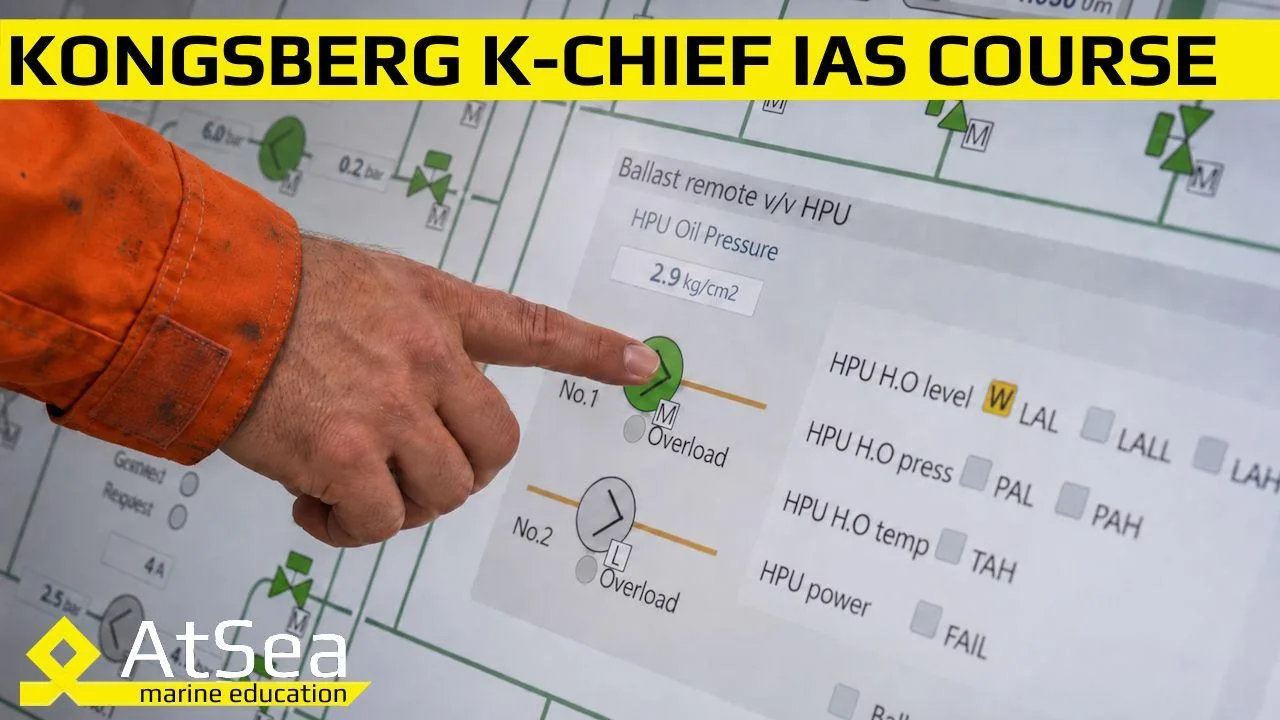
Monitoring parameters via the HMI (Human-Machine Interface) and Analyzer.
A dedicated module is focused on automatic control logic:
Calculating seawater flow rate.
The operation of the PID controller.
Regulation based on S/C and pH.
The relationship between Fuel Oil Consumption (FOC) load and water consumption.
What happens 30 minutes after system startup.
Significant attention is given to emergency situations and alarms:
SD1–SD5 alarms and their practical meaning for an engineer.
Which faults lead to an EGCS shutdown.
In which cases the system requires a switch to compliant fuel.
What to check during High Turbidity, Low pH, and High PAH alarms.
How to distinguish between a water-related problem and a combustion-related problem.
The course also develops a correct approach to operation from the perspective of PSC and MARPOL compliance:
Which parameters are recorded and why.
How to read trends and reports.
The most frequently asked questions by inspectors.
Which actions by the engineer are considered correct.
This course package is not a "check-the-box overview" but a practical tool for the ship's engineer, enabling them to:
Confidently start up and operate the scrubber.
Understand the system's logic instead of operating blindly.
Quickly identify the root cause of malfunctions.
Feel assured during inspections and audits.
Created by practitioners for practitioners, this course is designed for real-world work onboard modern vessels.